

Home › Blog › Large-Part CNC Machining
What Is Large-Part CNC Machining? Machine and Process Selection for Heavy Industry
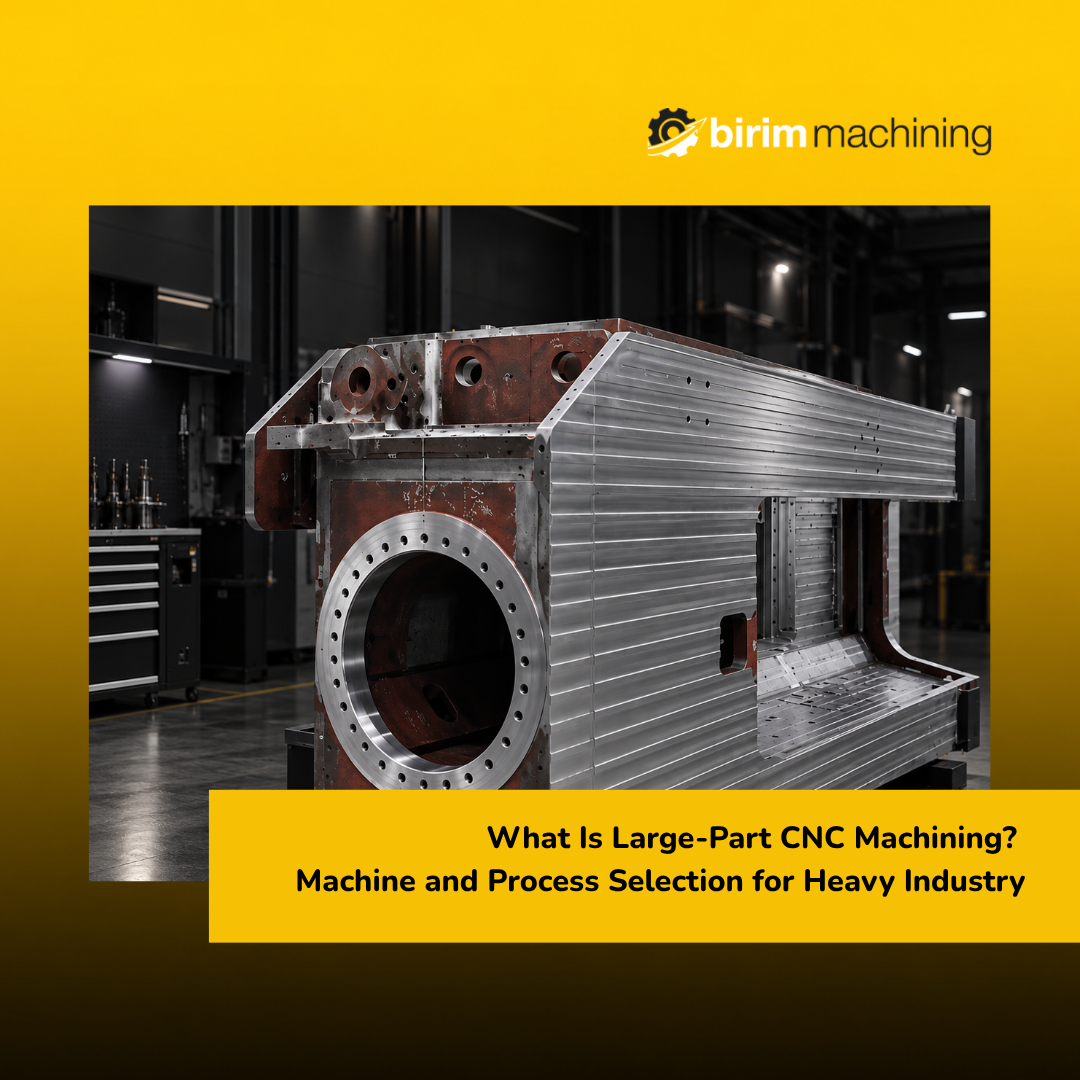
When a component becomes larger, longer or heavier, machining is no longer simply a matter of finding a CNC machine with enough travel. The workpiece still needs to be positioned securely, the required surfaces must remain accessible, and the selected machining process must meet the dimensional requirements defined by the technical drawing.
For this reason, Large-Part CNC Machining starts with the component itself. Its dimensions establish the physical limits, while its geometry and required operations influence which machine configuration and process are suitable. Looking at these factors together provides a more reliable basis for planning large-component production and evaluating a machining partner.
1 What Is Large-Part CNC Machining?
Large-Part CNC Machining covers CNC-controlled machining processes used for components whose dimensions, weight or geometry require equipment and production planning suited to larger workpieces. There is no single machining method that applies to every large component.
A long rotational part, for example, creates different requirements from a wide machine body or a component that needs machining across several surfaces. The appropriate machine configuration therefore depends on the workpiece and the operations defined by its technical drawing.
This distinction matters because physical size alone does not determine whether a machining setup is suitable. The workpiece must fit within the available machining area, but the selected equipment must also provide the movement and access required to machine the necessary features.
The presence of different machine configurations allows the requirements of a component to be considered against the available production equipment rather than relying on a single machine type.
2 Which Industries Require Large-Part Machining?
Large-component machining is relevant in industrial applications where substantial structural, rotational or machine components need to be produced. The requirement can arise in sectors such as machinery manufacturing, energy, mining, construction and other heavy-industry applications.
However, industry alone does not determine the machining process. Two components used within the same sector may require very different equipment because their dimensions, geometry and machined features are different.
Birim Machining operates across industrial fields including recycling, energy, mining, construction, hydraulic systems, defense, and machinery and equipment manufacturing. Within projects in these and other industrial fields, the machining requirements of an individual component still need to be evaluated according to its own technical specifications.
This is why Large-Part CNC Machining is better approached on a project basis. The technical drawing, component dimensions and required machining operations provide a more useful starting point than selecting a process based only on the industry in which the component will be used.
3 Which CNC Machines Are Used for Large Components?
Once the component requirements are understood, the next question is which machine configuration is appropriate for the required operations. There is no universal CNC machine for large parts because different workpiece forms create different requirements for movement, orientation and tool access.
Birim Machining's production line includes several equipment configurations relevant to machining operations, including CNC BORWERK MACHINE, CNC Vertical Lathe, CNC LATHE, VERTICAL MACHINING CENTER, DOUBLE-COLUMN MACHINING CENTER and PLATE BORWERK.
The important distinction is that these configurations are not interchangeable simply because they can work with substantial components. A rotational workpiece creates different machining requirements from a long structural component, while a broad part with features distributed across multiple areas introduces another set of considerations.
Machine selection in Large-Part CNC Machining should therefore follow the component and the operations required by its drawing. Machine capacity establishes an important physical boundary, but process suitability also depends on how the workpiece needs to be positioned and which areas must remain accessible during machining.
4 How Do Part Size and Geometry Affect Machine Selection?
Overall dimensions provide an initial indication of whether a workpiece can be accommodated by a particular machine. Yet fitting the nominal length, width or height of a component within the stated machine travel does not automatically make that machine suitable for the job.
The workpiece also needs to be positioned and held during machining. Tool access must remain available, while the machine needs sufficient movement to reach the features specified on the drawing. The practical working conditions therefore depend on the relationship between the machine, workpiece and setup rather than on a single capacity figure.
Geometry adds another consideration. Long components, large-diameter rotational parts and wide structural components do not create the same machining conditions. Features located on different faces may also influence workpiece orientation and whether additional setups are necessary.
For Large-Part CNC Machining, machine selection should therefore begin with the complete technical drawing rather than overall dimensions alone. Dimensions indicate whether the component can potentially be accommodated, while its geometry and machining requirements help determine which equipment and process are appropriate.
5 Why Are Tolerances Critical in Large-Part Machining?
Selecting suitable equipment is only one part of the production plan. The dimensions and tolerances specified on the technical drawing still determine whether machined features meet the requirements defined for the component.
Dimensional results can be influenced by several elements of the machining process, including machine condition, setup stability, workholding, machining strategy and thermal effects. For larger workpieces, these factors need to be considered throughout the machining sequence rather than treating dimensional control only as a final inspection activity.
Measurement therefore forms an important part of the process. Birim Machining states that CMM measurement is used within its quality-control capabilities.
Tolerance requirements in Large-Part CNC Machining should nevertheless be assessed according to the individual component and its technical drawing. A single general tolerance cannot be assumed for every large part. The required dimensional limits must instead be considered as part of the project-specific machining plan.
6 How Are Large Components Fixtured and Aligned?
Before machining begins, a component needs to be positioned and held appropriately for the planned operations. Fixturing provides the support and restraint required during machining, while alignment establishes the relationship between the physical workpiece and the machining reference.
The appropriate setup depends on the component. Workpiece geometry, machining direction, accessible surfaces and the operations to be performed all influence how the part needs to be positioned. It must be held securely while maintaining access to the areas that require machining.
Alignment is closely connected to this setup. If the physical position of the workpiece does not correspond correctly with the machining reference, machined features may not be positioned as intended relative to other areas of the component.
For this reason, fixturing and alignment in Large-Part CNC Machining should be considered as part of process planning. There is no single setup method that can be applied to every large component; the appropriate approach depends on the geometry and machining requirements of the individual workpiece.
7 How to Choose a Large-Part CNC Machining Partner
Maximum machine dimensions are a useful starting point when evaluating a machining supplier, but they do not describe the complete production capability. A machine may be able to accommodate a component while its configuration is not the most appropriate for the geometry or required operations.
A more useful evaluation considers the complete path from the technical drawing to dimensional control. The available equipment needs to match the component geometry and required operations, while production planning and measurement capabilities should support the machining process.
When comparing potential partners, four connected areas are particularly useful to examine:
- Machine capacity: Can the available equipment accommodate the component and the required setup?
- Machine configuration: Is the available equipment suitable for the geometry and machining operations?
- Production planning: Can the machining route be planned around the technical drawing and project requirements?
- Dimensional control: Are appropriate measurement capabilities available to evaluate the required dimensions?
Considering these factors together provides a more complete picture than comparing maximum machine dimensions alone.
For Large-Part CNC Machining projects, evaluating the technical drawing, component dimensions and machining requirements together provides a stronger basis for selecting the appropriate equipment and planning the machining process.
Discuss Your Machining Project
Share your technical drawing, component dimensions and required machining operations, and Birim Machining will evaluate which equipment and process are appropriate for the project.
Contact Birim MachiningQuick Recap
What is large-part CNC machining?
CNC-controlled machining processes used for components whose dimensions, weight or geometry require equipment and production planning suited to larger workpieces. There is no single machining method that applies to every large component.
Which industries require large-part machining?
Industrial applications where substantial structural, rotational or machine components are produced, including machinery manufacturing, energy, mining and construction. Industry alone does not determine the process, because two components in the same sector may require very different equipment.
Which CNC machines are used for large components?
There is no universal machine for large parts. Birim Machining's production line includes CNC borwerk machine, CNC vertical lathe, CNC lathe, vertical machining center, double-column machining center and plate borwerk configurations, and these are not interchangeable simply because they can work with substantial components.
Is machine travel enough to decide whether a machine is suitable?
No. Fitting the nominal length, width or height of a component within the stated machine travel does not automatically make that machine suitable. The workpiece must also be positioned and held, tool access must remain available, and the machine needs sufficient movement to reach the features on the drawing.
Can a single general tolerance be assumed for large parts?
No. Tolerance requirements should be assessed according to the individual component and its technical drawing, and the required dimensional limits considered as part of the project-specific machining plan. Birim Machining states that CMM measurement is used within its quality-control capabilities.
What should be examined when choosing a large-part machining partner?
Four connected areas: machine capacity, machine configuration, production planning and dimensional control. Considering these together provides a more complete picture than comparing maximum machine dimensions alone.
Explore more: All Services · Welding · Hydraulic Cylinder Production · Sheet Cutting and Bending · Contact